Tennis Court Gravel Base: Road Base Depth & Quantities
A durable tennis court starts with a properly constructed base that ensures consistent ball bounce and player safety. This guide explains what a tennis court is, which materials you need, how to prepare the ground, how to build the court step by step, and how to estimate the amount of gravel required. Whether you are planning a backyard recreational court or a professional-grade installation, use the sections below to navigate through the process.
See How to Build a Tennis Court
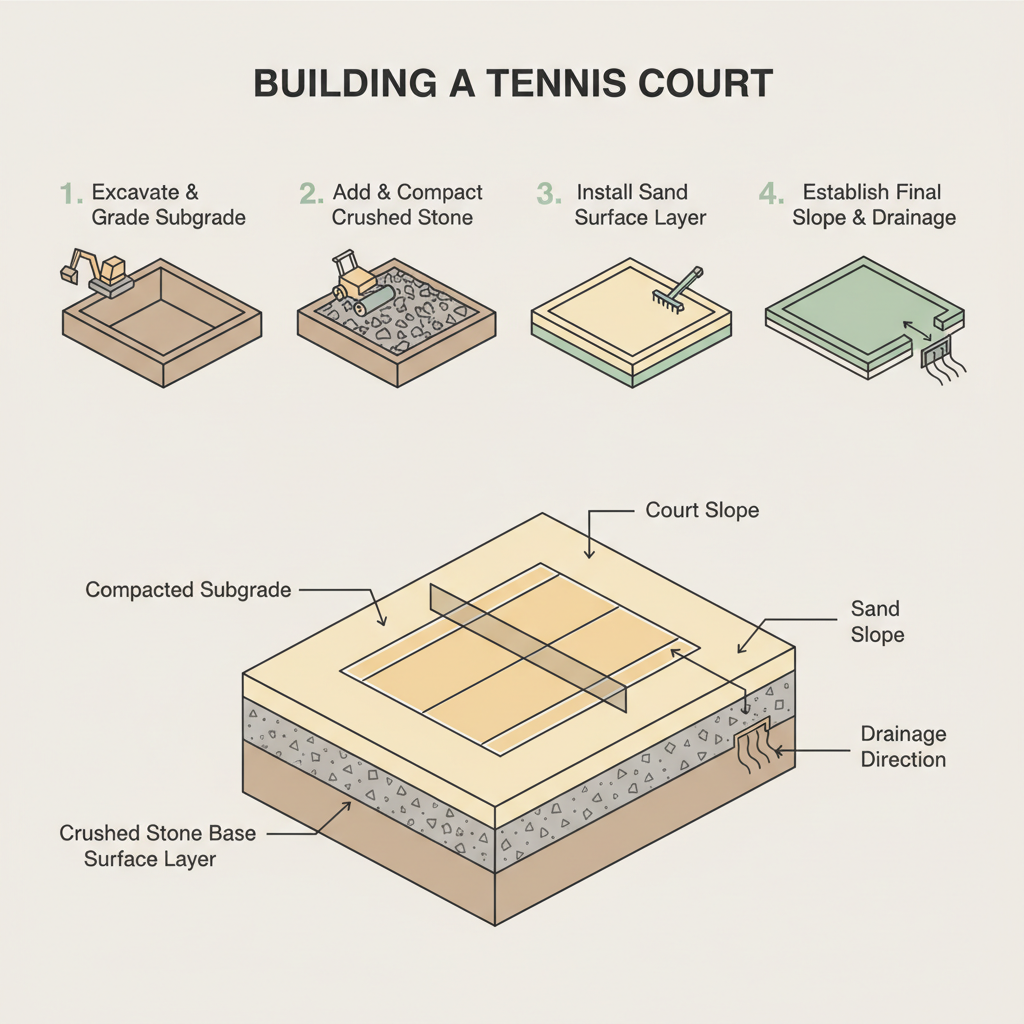
This visual guide illustrates the step-by-step installation sequence for building a tennis court, showing how each numbered task builds upon the previous one. It also clarifies the essential layered structure—from compacted subgrade to sand surface—that ensures proper drainage and a stable playing field. Following this diagram helps visualize the complete construction process and material placement.
Gravel for Tennis Courts: Best Materials, Depth, Cost & How to Build
Building a tennis court requires a stable, well-draining foundation that can withstand heavy use and seasonal changes. Crushed stone in a 3/4-inch down to fines grading provides the ideal base material, offering both structural integrity and proper water management. An 8-12 inch total depth ensures adequate support for the playing surface while maintaining the necessary slope for drainage away from the court. This layered approach prevents standing water and maintains court integrity through all weather conditions.
How This Tennis Court Is Built (Layer-by-Layer System)
A tennis court is built as a multi-layer system designed to provide a stable, well-draining playing surface. The construction begins with a properly graded and compacted subgrade, followed by a layer of gravel that serves as a load-bearing foundation. A sand layer creates a smooth, level playing surface above the gravel base, with proper slope ensuring efficient water drainage away from the court. This layered approach prevents standing water and maintains court integrity through seasonal changes.
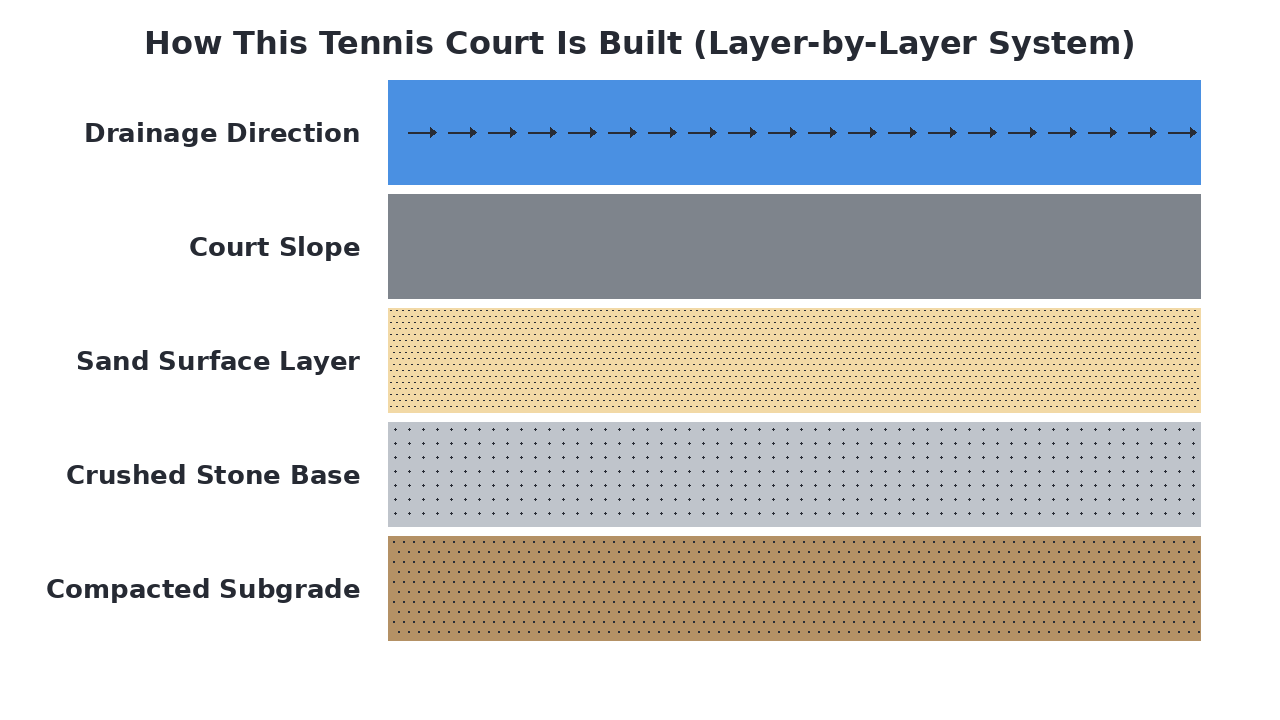
Materials Breakdown: What Each Layer Does
A tennis court is built as a layered system, with each material serving a distinct structural or functional purpose. The layers work together to create a stable, level, and well-draining playing surface that can withstand heavy use and weather. Choosing the right product for each component ensures the court performs consistently and lasts for years.
Compacted Subgrade
The native soil that is graded and compacted to provide a firm, stable foundation for the entire court structure.
Crushed Stone
A layer of angular, compacted crushed stone that provides load-bearing strength, frost resistance, and drainage for the court.
View Crushed Stone →Sand
A fine, level layer of sand that creates a smooth, cushioned playing surface and allows for proper ball bounce.
View Sand →Surface Slope
The slight, consistent grade built into the court surface to direct rainwater off the playing area and prevent puddling.
Drainage Direction
The planned path for water runoff, ensuring precipitation flows away from the court surface to avoid damage and maintain playability.
What Is a Tennis Court and Why Does It Matter?
A tennis court is a specialized playing surface designed for the sport of tennis, requiring specific construction to ensure proper ball bounce, player safety, and durability. It matters because a properly built court provides consistent playability, prevents water damage, and extends the court's lifespan through seasonal changes. Unlike simple paved surfaces, tennis courts use a multi-layer system with proper drainage and slope to maintain integrity, differing from casual recreational surfaces that may lack the structural support and drainage needed for competitive play.
Common Types of Tennis Court Systems
Tennis court systems come in several types based on their playing surface and construction method. The most common are clay courts, hard courts (acrylic or asphalt), and grass courts, each offering different ball speed and maintenance requirements. Clay courts provide slower play with high bounce, while hard courts offer consistent speed and durability. Grass courts deliver fast play but require extensive upkeep and specialized conditions.
- Realistic, maintainable backyard option
- Asphalt or concrete on a compacted road-base sub-base (HG delivers the sub-base)
- Acrylic surface coating for line work and color
- Consistent ball bounce; durable all-weather
Best for:Most backyard tennis builds
- Authentic slower play; lower joint impact
- Requires calcined-clay topping (Har-Tru, Rubico, fast-dry) — not generic crushed stone
- Engineered sub-base and irrigation; significant maintenance
- Topping material usually sourced from specialty suppliers, not HG
- HG can supply the gravel sub-base layers under the topping
Best for:Buyers committed to a true clay surface and ongoing maintenance
- Synthetic grass + sand infill on a stone sub-base
- Consistent year-round play; low maintenance
- Turf and infill sourced separately
- HG supplies the stone sub-base
Best for:Low-maintenance backyards
- Highest maintenance; specialized drainage and mowing
- Limited play seasons
- Not generally practical for backyard installs
Best for:Tennis enthusiasts with significant grounds-keeping commitment
When a Tennis Court Is the Best Solution
A clay tennis court is ideal when you want traditional play with reduced joint impact and excellent drainage. It's perfect for homeowners who value the classic tennis experience and have space for proper court dimensions. Choose this option if you're willing to perform regular maintenance like rolling and watering to keep the surface in optimal condition. The crushed stone base provides natural playability that many tennis enthusiasts prefer over synthetic surfaces.
Everything You Need to Build a Tennis Court
Building a durable tennis court requires specific foundational and surfacing materials, along with essential grading and compaction tools. The project starts with a compacted subgrade, followed by a crushed stone base for drainage and stability, and a final sand surface layer for a consistent playing texture. You will also need tools for excavation, precise leveling, and compaction to achieve the required court slope and proper drainage direction.
- Compacted subgrade soil, Crushed stone base, Sand surface layer, Court edging (optional), Drainage pipes (optional)
- Excavator or shovel, Laser level or transit, Plate compactor, Grading rake, String line and stakes
- Hello Gravel (materials), Sunbelt Rentals (excavator, compactor rental), A contractor supply store (grading tools)
What to Consider Before You Start
Careful planning is essential for a successful tennis court build. Review this checklist to address key considerations before breaking ground.
- Site preparation and drainage
Verify the site has adequate drainage away from the court and plan for any necessary drainage pipes or grading adjustments.
- Local regulations and permits
Check with your local building department for any required permits, zoning restrictions, or setback requirements for a tennis court.
- Court dimensions and orientation
Confirm the official court dimensions and decide on the optimal north-south orientation to minimize sun interference for players.
- Soil testing and stability
Test the native soil for stability and compaction needs to ensure a solid, long-lasting subgrade foundation.
- Material quantity calculations
Accurately calculate the volume of crushed stone and sand needed based on your court's dimensions and layer depths.
How to Prepare the Ground for a Tennis Court
Start by clearing the entire site of all vegetation, roots, and debris to establish a clean working area. Mark the precise boundaries of the court, then grade the ground to establish the proper slope for drainage, typically a 1% to 2% fall across the width. Finally, thoroughly compact the exposed subgrade to create a firm, stable, and level foundation that prevents future settling.
How a Tennis Court Works
The court functions as a multi-layered system where the compacted subgrade provides foundational stability. A crushed stone base layer distributes player loads and manages subsurface water, while a sand surface layer creates a consistent, cushioned playing texture. The entire structure is sloped to direct surface water toward perimeter drainage channels, ensuring the court remains dry and playable after rain.
How to Install a Tennis Court
Excavate & Grade Subgrade
⚠️ Licensed-trade notice: This project is code-regulated in most jurisdictions and typically requires a licensed contractor and local permits. The steps below are provided to help plan your aggregate order, not as a substitute for professional design, permits, or inspections. Excavate the marked area to the required depth and grade it to the precise slope for drainage.
Add & Compact Crushed Stone
Spread and mechanically compact a thick layer of crushed stone to form a stable, load-bearing base.
Install Sand Surface Layer
Apply and screed a uniform layer of specialized sand to create the final playing surface.
Establish Final Slope & Drainage
Verify the overall slope and install any necessary perimeter drains to manage water runoff.
Alternative Gravel Options for Tennis Courts
While crushed stone is the standard base for tennis courts, several other aggregates can be considered for different layers or specific conditions. Fine materials like sand or clay can be used for leveling and surface finishing, while larger gravel may serve as a sub-base in well-draining soils. However, crushed stone consistently wins for its optimal combination of stability, drainage, and compaction properties that create a durable playing surface.
Ideal as the primary base layer for its excellent compaction and drainage.
View Product →Provides a firm surface but requires careful moisture management.
Too loose and unstable for any structural layer of a tennis court.
View Product →Common Tennis Court Mistakes (And How to Avoid Them)
Building a tennis court requires precision in both materials and construction techniques. Common mistakes often compromise the court's playability and longevity. Avoiding these errors ensures a professional-quality playing surface.
- Insufficient base depth
- Poor drainage planning
- Inadequate compaction
- Wrong surface material
- No proper grading
How to Maintain a Tennis Court
Regular maintenance keeps a tennis court safe and playable. Monthly inspections should check for surface irregularities, drainage issues, and wear patterns. Address minor depressions promptly with proper leveling material, and annually top-dress with appropriate surface material to maintain consistency. Keep drainage channels clear and vegetation controlled around court edges.
Calculate How Much Gravel You Need
Enter Your Dimensions
Measure your project area and we'll calculate how much material you need.