Order Road Base for Your AC Pad Sub-Base
An AC pad provides essential stability and drainage for your outdoor air conditioning unit. This guide explains what an AC pad is, which materials you need, how to prepare the ground, how to install a gravel AC pad step by step, and how to estimate the amount of gravel required. Whether you are replacing an old concrete pad or installing a new unit on a gravel base, use the sections below to jump to the information you need.
See How to Build an AC Pad
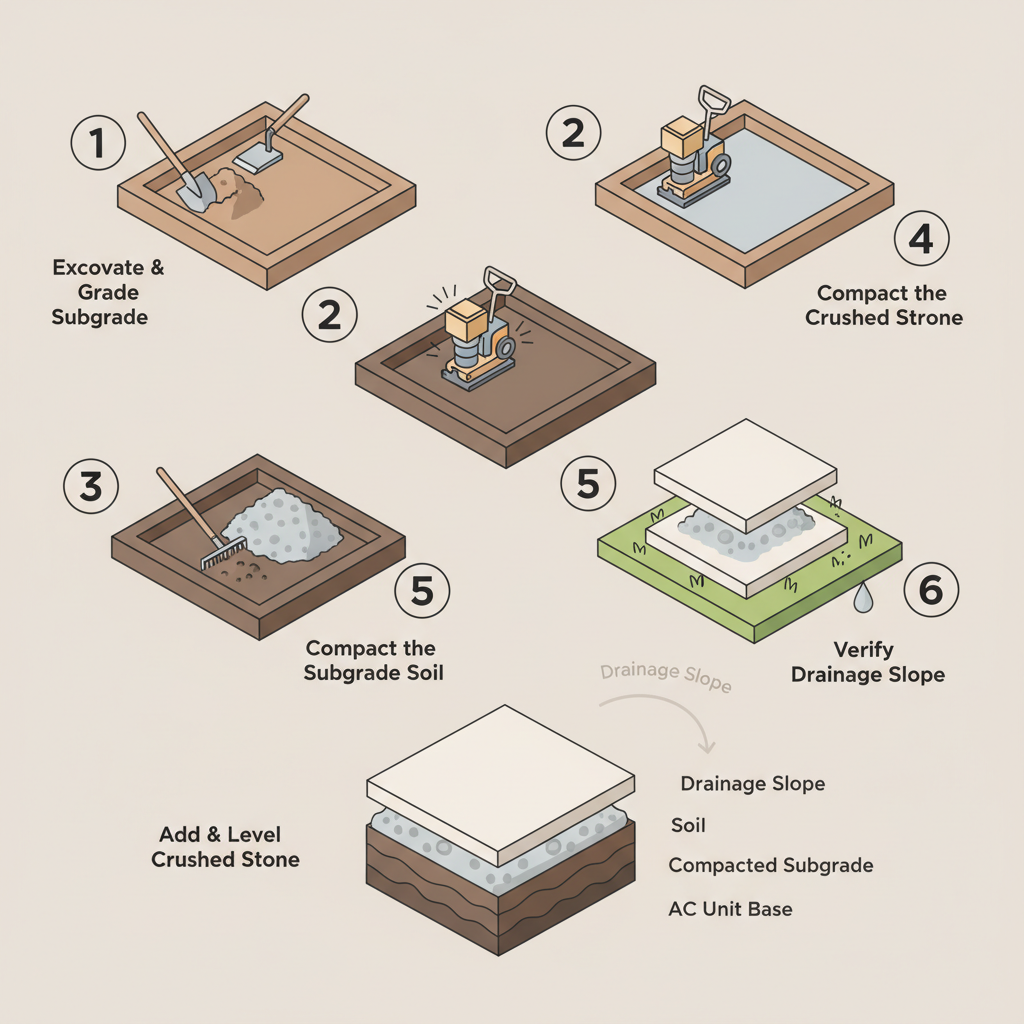
This visual guide shows the complete installation sequence for building a stable AC pad, from excavation to final leveling. The numbered steps clarify the proper order of operations, while the layered cross-section reveals how each material contributes to drainage and support. This infographic helps you visualize the entire process before starting your project.
Gravel Base Under an AC Pad: Sizes, Depth, and How Much You Need
An AC condenser needs a level, rigid pad — typically a concrete or composite pad — sitting on a compacted gravel sub-base. We recommend a 4–6 inch compacted layer of road base under the pad for drainage and to prevent settling. A typical 3 ft × 3 ft residential pad needs 1–2 tons of road base for the sub-base. The pad on top must comply with IMC §304.10 / IRC §M1305.1.4.1 and your manufacturer's installation instructions; check with your local building official before installing.
How This AC Pad Is Built (Layer-by-Layer System)
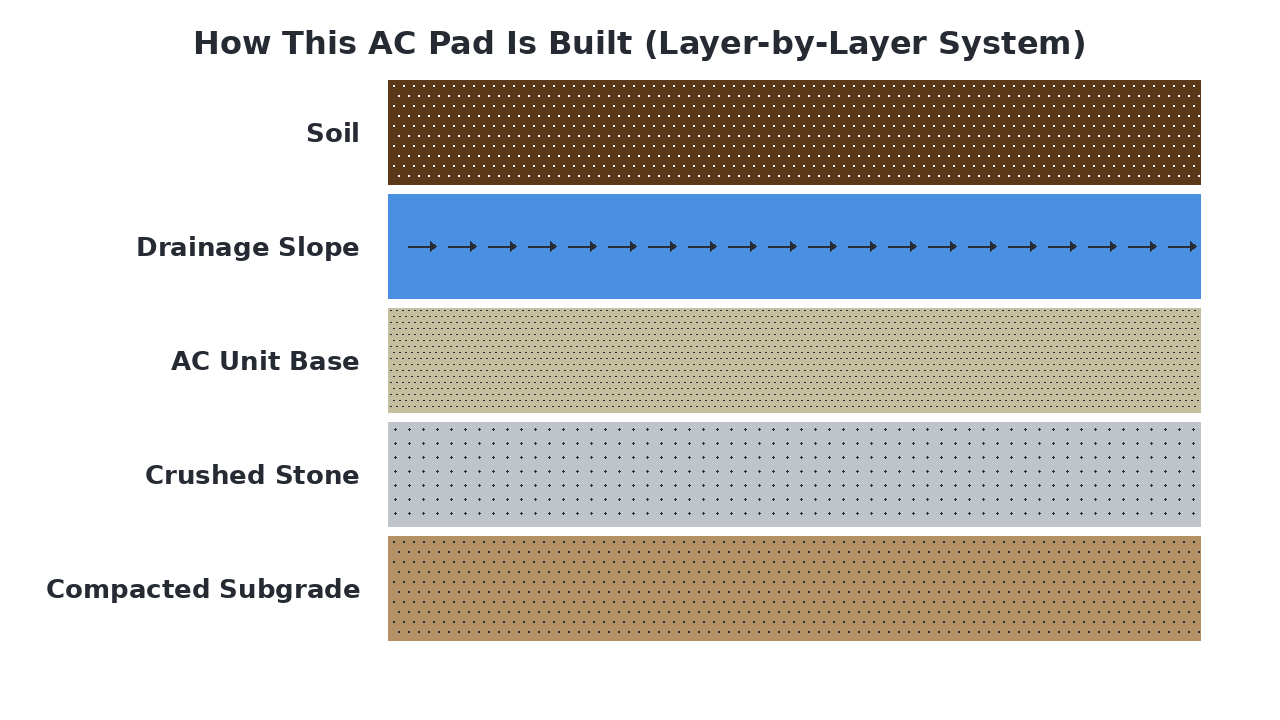
An AC pad is a layered foundation system designed to support the weight of an air conditioning unit while ensuring proper drainage and stability. The system begins with a compacted subgrade that provides a solid base, followed by a layer of crushed stone that creates a durable, load-bearing surface for the unit. Proper construction includes leveling the crushed stone layer to support the AC unit evenly while maintaining a slight slope away from the house to direct water runoff. This multi-layer approach prevents settling, protects against erosion, and extends the lifespan of both the pad and the equipment it supports.
Materials Breakdown: What Each Layer Does
An AC pad is constructed as a layered system where each material serves a specific structural and functional purpose. The components work together to provide a stable, level foundation that supports the air conditioner's weight while ensuring proper drainage away from the unit. Selecting the right product for each layer prevents settling, maintains the unit's alignment, and protects against moisture damage over time.
Native Soil
The existing ground that is leveled and compacted to create a firm, stable base for the entire pad structure.
Crushed Stone
A compactable aggregate layer that provides drainage and prevents frost heave while distributing the AC unit's weight evenly.
View Crushed Stone →Concrete Pad
A solid, level surface that directly supports the air conditioner, keeping it stable and preventing vibration or shifting.
Drainage Slope
A slight grade away from the AC unit that directs rainwater and condensation runoff away from the foundation.
Topsoil
Surface soil that surrounds the pad, providing a finished appearance and allowing for proper water absorption around the area.
View Topsoil →What Is an AC Pad and Why Does It Matter?
An AC pad is a specifically engineered foundation designed to support the weight of an air conditioning unit while providing proper drainage and preventing soil erosion. It matters because a properly constructed pad prevents settling, protects against water damage, and extends the lifespan of your expensive HVAC equipment. Unlike simply placing a unit on bare ground or a concrete slab, a layered gravel pad with proper drainage slope allows for water runoff and accommodates soil movement, making it more resilient and maintenance-free over time.
Common Types of AC Pad Systems
AC pads typically use a layered gravel foundation to support the HVAC unit, with variations in the surface material and construction method. The most common options include a simple gravel bed, a gravel bed topped with a concrete slab, or a prefabricated plastic pad. Each choice balances cost, durability, drainage performance, and ease of installation.
- Code-compliant per IMC §304.10 / IRC §M1305.1.4.1
- Compacted gravel sub-base prevents settling
- Concrete pad provides level, rigid support per manufacturer specs
- Long-lasting with minimal maintenance
Best for:Standard residential AC installations and warranty compliance
- Polymer composite pads sized for residential condensers
- Quick installation; no concrete cure time
- Same compacted gravel sub-base as Option 1
- Confirm pad model is approved by your local AHJ
Best for:Faster installs where the AHJ accepts pre-cast pads
- Not recommended — typically does not meet IMC §304.10 / IRC §M1305.1.4.1
- Most condenser warranties require a level rigid pad
- Inspectors often red-tag gravel-only installations
- Use only if your local code official has explicitly approved this
Best for:Not generally recommended for condenser installations
When an AC Pad Is the Best Solution
A gravel AC pad is ideal when you need a cost-effective, durable foundation that handles drainage naturally. It's perfect for standard residential units where soil movement and water runoff are concerns, avoiding the expense and permanence of concrete. Choose this option if you want a DIY-friendly solution that prevents settling and protects your HVAC investment for years.
Everything You Need to Build an AC Pad
Building an AC pad requires several foundational materials and basic tools to create a stable, level base. You'll need crushed stone for the main structural layer, concrete or a pre-formed AC unit base for the top surface, and sand for fine leveling. Essential tools include a shovel, rake, and compactor to properly excavate, spread, and compact each layer.
- Crushed stone, Concrete or AC unit base, Sand
- Shovel, Rake, Compactor, Level, Tape measure
- Hello Gravel (materials), Your local hardware store, Equipment rental store (compactor)
What to Consider Before You Start
Before digging, review these key considerations to ensure your AC pad will be properly sized, located, and constructed.
- Pad size and location
Verify the pad dimensions exceed your AC unit's footprint by at least 6 inches on all sides and confirm the chosen spot allows for proper airflow and service access.
- Drainage requirements
Plan for a slight slope (about 1/4 inch per foot) away from your home to ensure water drains effectively from the pad.
- Soil type and compaction
Check your soil's stability; clay or loose soil may require additional excavation and compaction to prevent future settling.
- Local codes and permits
Research if your municipality requires a permit or has specific setback rules for AC unit placement.
- Utility line clearance
Call 811 or your local utility locating service to mark any underground lines before you start digging.
How to Prepare the Ground for an AC Pad
Start by clearing the area of all vegetation, roots, and debris to create a clean work zone. Mark the perimeter of the pad, ensuring it extends at least 6 inches beyond the AC unit's footprint on all sides. Excavate the soil to the required depth, then grade the subgrade to create a slight drainage slope away from the home's foundation. Finally, thoroughly compact the exposed subgrade soil to create a stable, unyielding base for the subsequent layers.
How an AC Pad Works
The AC pad functions as a multi-layer foundation that distributes the unit's weight evenly across the compacted subgrade, preventing settling and maintaining level alignment. A crushed stone base provides load-bearing support and facilitates internal drainage, while the AC unit base offers a smooth, stable surface for the equipment. The entire pad is constructed with a gentle slope that directs surface water and condensation runoff away from the unit and the home's structure, protecting against moisture-related damage.
How to Install an AC Pad
Excavate & Grade Subgrade
⚠️ Licensed-trade notice: AC condenser installation is regulated under IMC §304.10 / IRC §M1305.1.4.1 and your manufacturer's installation instructions. The unit typically must sit on a level concrete or composite pad approved by your local building official. The steps below are provided to help plan your gravel sub-base order, not as a substitute for professional installation, permits, or inspection. Dig out the marked area to the required depth and shape the soil to create a slight slope for drainage.
Compact the Subgrade Soil
Use a plate compactor to thoroughly compact the excavated soil, creating a firm and stable foundation layer.
Add & Level Crushed Stone
Spread a layer of crushed stone over the compacted subgrade, leveling it to the correct thickness and maintaining the drainage slope.
Compact the Crushed Stone
Compact the crushed stone layer to achieve a dense, load-bearing base that resists settling.
Place AC Unit Base
Set the pre-formed AC unit base or pour a concrete pad on top of the compacted stone, ensuring it is level and properly positioned.
Verify Drainage Slope
Use a level to confirm the final pad surface has the correct slope to direct water away from the unit and foundation.
Alternative Gravel Options for AC Pads
For an AC pad, the primary layer needs a compactable, stable aggregate that provides a solid foundation while allowing drainage. Crushed stone is often the best choice because it locks together under compaction and resists shifting under the weight of the unit. Pea gravel and sand are less suitable as they can shift or wash away, while concrete offers maximum stability but at higher cost and complexity.
Ideal for the main base layer due to its excellent compaction and drainage properties.
View Product →A decorative option that can be used as a top layer for appearance but lacks stability for the base.
View Product →Provides a permanent, solid pad but requires professional installation and proper curing.
View Product →Poor choice for the base as it shifts easily and does not provide adequate support.
View Product →Common AC Pad Mistakes (And How to Avoid Them)
A stable, long-lasting AC pad requires careful planning and execution. Avoid these frequent errors to prevent settling, poor drainage, and unit damage.
- Insufficient base depth
- Poor drainage slope
- Using wrong aggregate
- No compaction
- Ignoring weed barrier
How to Maintain an AC Pad
Regularly inspect the pad for settling or erosion, especially after heavy rains. Top up any low spots with fresh crushed stone and re-compact to maintain a level surface. Keep the area around the pad clear of debris and vegetation to ensure proper airflow and drainage.
Calculate How Much Gravel You Need
Enter Your Dimensions
Measure your project area and we'll calculate how much material you need.